Technology
Technology is changing every aspect of how we live and work, and Ireland is at the centre of that shift. But with rapid change comes real challenges, from the energy demands of our digital infrastructure to the biases embedded in the systems we build. Our university researchers are working to make sure Ireland’s technology future is sustainable, fair and built on solid evidence.
How we’re supporting Government:
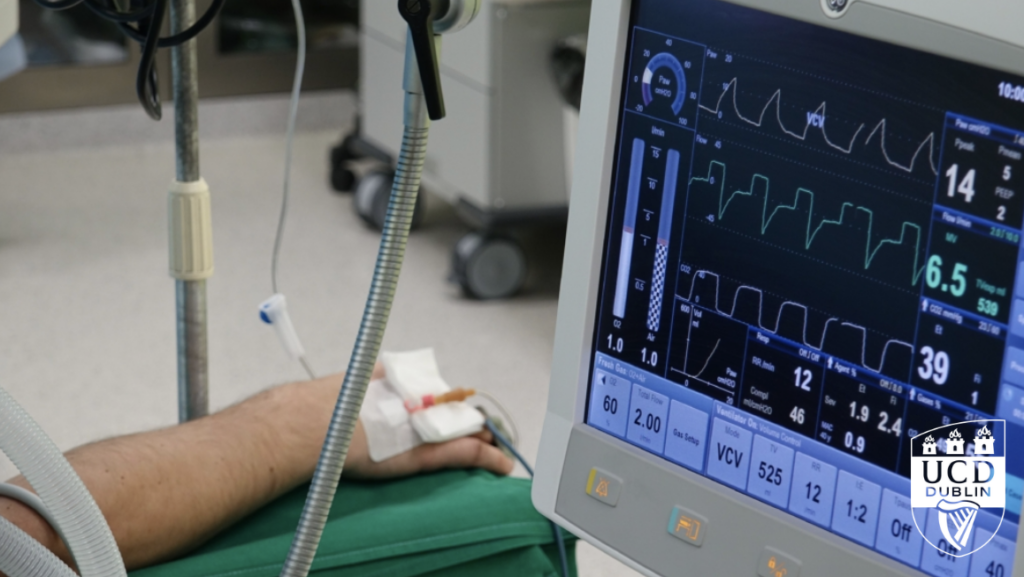
UCD are humanising the algorithm: where data meets compassion to fight pneumonia and sepsis
The Challenge: Pneumonia and Sepsis are deadly diseases and the leading cause of deaths worldwide. Currently the tools used to detect these diseases are slow. This leads clinicians to treat patients using a broad spectrum of antibiotics as treatment which can increase antimicrobial resistance
The Solution: To detect pneumonia and sepsis in a faster way by using data from ICU patients and artificial intelligence.
University Delivery: Professor Patricia B Maguire and Research Scientist, Vanessa Carvalho, UCD School of Biomolecular Biomedical Science are harnessing the power of data and artificial intelligence to deliver critical decision support for doctors, enabling faster and earlier recognition of life-threatening conditions such as pneumonia and sepsis in intensive care settings. When every minute counts, timely decisions can save lives. While the research is still ongoing, it already holds significant promise for transforming how critical care is delivered, helping healthcare teams respond more quickly and precisely. This project is not just about technology, but about giving patients a fighting chance at survival and ensuring that no life is reduced to a series of numbers on a screen. The team believes that behind every line of code is a human story of fear, suffering, resilience and hope.

TCD are uncovering how gender bias shapes the way we interact with AI.
The Challenge: Some AI systems are assigned a gender, like a female voice assistant or a male chatbot. A study of 402 participants found that people exploited female AI more and distrusted male AI more. Left unaddressed, these biases shape how AI is built and governed.
The Solution: Understanding where these biases come from and using that knowledge to build AI systems that are fairer and work better for everyone.
University Delivery: Sepideh Bazazi and Professor Taha Yasseri, Trinity School of Social Sciences and Philosophy, conducted the first study of its kind into how gender bias shapes the way people interact with AI. Published in iScience, their work shows that giving an AI a gender changes how people treat it, and their findings are already informing how AI systems should be designed and governed.

DCU are developing next generation cooling technology for data centres.
The Challenge: Data centres need massive amounts of energy just to stay cool. As Ireland’s reliance on data grows, finding more sustainable cooling solutions is becoming urgent.
The Solution: Developing new cooling technology using nanofluid additives that reduce the energy data centres need to operate.
University Delivery: Dr Lorna Fitzsimons, DCU School of Mechanical and Manufacturing Engineering, and Dr Darren Fayne, DCU School of Chemical Sciences, are leading the DLCool project in collaboration with HT Materials Science and Exergyn, both based at the DCU Innovate Hub. The project has secured €2.3m from the Government’s Disruptive Technologies Innovation Fund to develop advanced cooling solutions for data centres.

UCC is developing smart digital health systems to improve maternal and child health outcomes globally.
The Challenge:Sub-Saharan Africa accounts for 70% of global maternal deaths, with infectious diseases such as HIV, malaria, and sepsis as leading contributors. Health systems are hindered by fragmented, paper-based records, preventing early detection and timely care for preventable conditions.
The Solution:A scalable, interoperable digital health information system that replaces paper records with real-time electronic registries, enabling improved clinical care, disease surveillance, and public health research at lower cost.
University Delivery: Professor Ali Khashan from UCC’s School of Public Health and INFANT Research Centre is leading the €4.9 million LINDA-FAMILIA project, funded under Horizon Europe. The initiative deploys an open-source digital health system across four regions in Ethiopia, Rwanda, Tanzania, and Uganda, integrating 11 WHO-recommended digital health interventions to track infectious diseases and support maternal and child health services. The system is designed for low-resource settings where internet coverage is unreliable, empowering local health workers with the information they need to make safer choices. The 11-partner consortium includes institutions from Ireland, the UK, Norway, and East Africa.

UL discovery could revolutionise the carbon fibre industry.
The Challenge: Reduce the input costs as we build our infrastructure and develop our economy.
The Solution: Develop a new method of producing carbon fibre, a high-cost lightweight material used in sectors such as aerospace, wind energy, construction and transportation.
University Delivery: Professor Maurice Collins and Associate Professor Anne Beaucamp McLoughlin, from the School of Engineering and UL’s Bernal Institute, are developing a groundbreaking new method of producing carbon fibre while drastically reducing its energy footprint. The CARBOWAVE project uses an innovative plasma and microwave heating method to make carbon fibre, replacing conventional heating processes and significantly reducing energy consumption by as much as 70% while maintaining the material’s performance. The reduction in energy required will make the process greener and less expensive, with the project set to transform the energy-intensive carbon fibre industry.

University of Galway is using AI to transform how hypertension is treated.
The Challenge: Hypertension affects more than 1.3 billion people worldwide and is a leading cause of premature death, yet treatment decisions can be complex and difficult to personalise.
The Solution: Healthcare professionals need a comprehensive, real-time decision support tool that combines patient, healthcare and clinical trial data to deliver personalised treatment recommendations at the right time.
University Delivery: Through the ARC Hub for HealthTech, Dr Conor Judge and his multidisciplinary team at University of Galway are developing AI-BP, an artificial intelligence-powered clinical decision support platform that integrates with electronic health record systems to support more consistent, accurate and timely hypertension care.